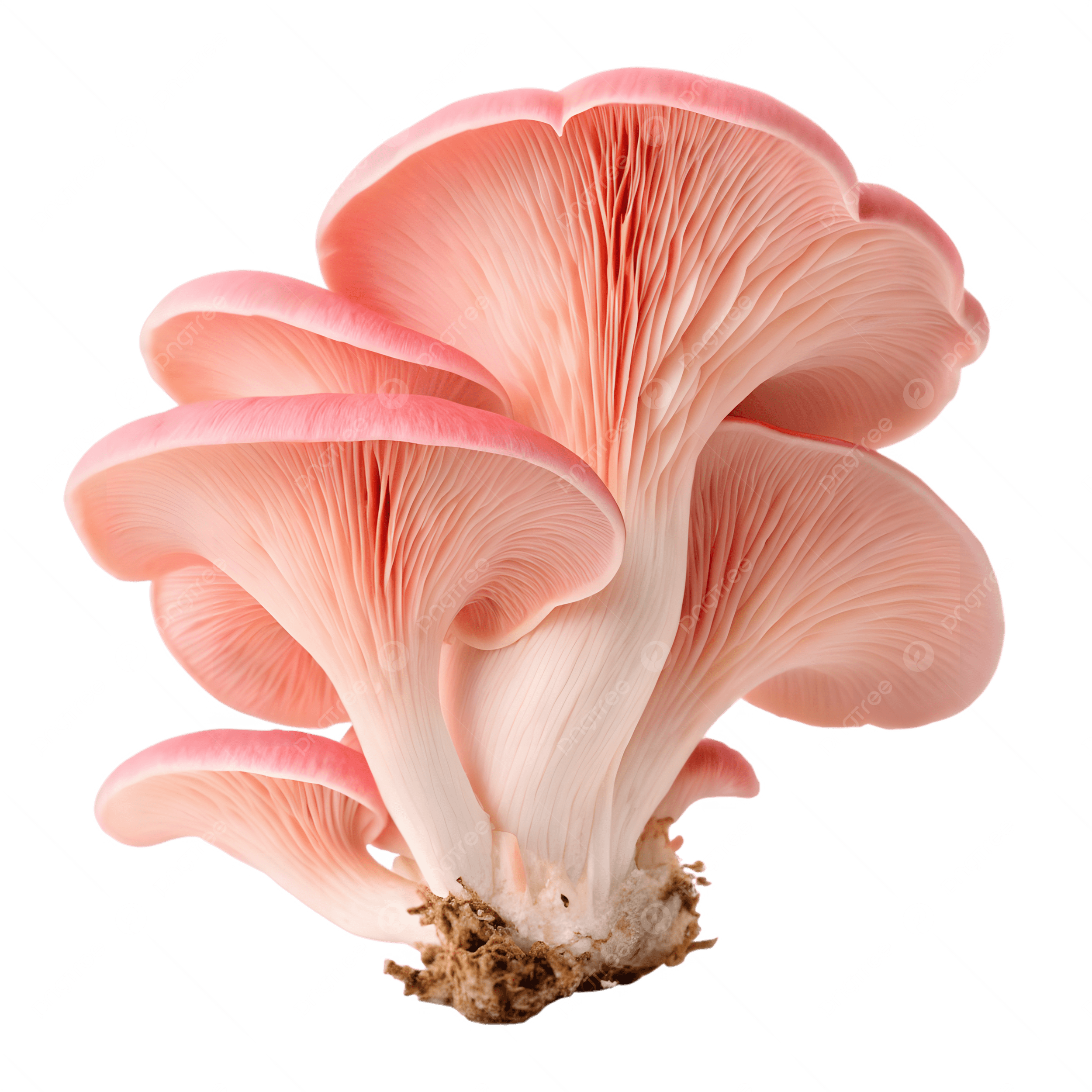
Pleurotus djamor · pink oyster
what it is
An electrode pair touching a fungal substrate, sampled once a second.
Mushrooms produce small, slow electrical activity — long-period spikes
that some researchers think function as a kind of internal language.
This page is a window onto that activity, in real time.
fungal voltage range
Reported spike amplitudes per species. Almost everything sits below
5 millivolts. The amber band on the chart marks the canonical
0.03 – 2.1 mV range for Pleurotus djamor.
| species | amplitude | duration |
|---|
| Pleurotus djamor | 0.03 – 2.1 mV | 1 – 21 h |
| Pleurotus ostreatus | 0.1 – 4 mV | min – h |
| Schizophyllum commune | 0.5 – 5 mV | 0.5 – 4 h |
| Ganoderma resinaceum | 0.5 – 2 mV | 1 – 6 h |
| Cordyceps militaris | 0.5 – 3 mV | hours |
| mycelium (generic) | 30 µV – 1 mV | varies |
what to look for
- Spikes are slow. A real fungal spike is minutes to hours wide,
not milliseconds. At 1 Hz sampling this is comfortably oversampled.
- Trains, not singletons. Adamatzky finds two clear rhythms in
P. djamor — a fast train (~4 min between spikes) and a slow one (~50 min).
Isolated bumps are usually noise; clustered spikes are interesting.
- Stimulus > rest. Resting activity sits at the low end.
Feeding, light, humidity changes, or heat stimulus push spikes up to
the 2–5 mV range.
- Polarity flips. A real spike usually shows a depolarisation
followed by a slow return. Both polarities occur.
about the current trace
The sensor here is a 16-bit ADC (most likely an ADS1115) reading
differential voltage. In its current full-scale range, the smallest
step it can resolve is ~187 µV per least-significant bit.
That means anything below ~190 µV literally cannot be measured —
the lower part of the fungal range (30 µV) is invisible to this
configuration.
If the trace looks like it sits at three or four discrete levels,
that is the ADC's quantisation grid showing through, not a real signal.
A more sensitive PGA gain or a 100× preamp ahead of the ADC would
drop the smallest visible voltage to single-digit microvolts.
sources
Adamatzky, A. (2018). On spiking behaviour of oyster fungi
Pleurotus djamor. Scientific Reports, 8:7873.
Adamatzky, A. (2022). Language of fungi derived from their
electrical spiking activity. Royal Society Open Science, 9:211926.
Mayne, R. & Adamatzky, A. (2024). Electrical activity in
oyster mushroom mycelium. UWE Bristol, Unconventional Computing Lab.
Olsson, S. & Hansson, B. S. (1995). Action potential-like
activity found in fungal mycelia is sensitive to stimulation.
Naturwissenschaften, 82:30–31.
 zwamgeest · sensor